
Industrial Load Securement Equipment Selection
A load that shifts by only a few inches can damage cargo, compromise vehicle control, injure personnel, and turn a routine delivery into unplanned downtime. Industrial load securement equipment is not a generic accessory category. It is a safety-critical system that must match the load, the transport method, the anchor points, and the conditions crews will face from departure through unloading.
For oilfield, construction, maritime, and heavy-equipment operations, the right selection starts with verified capacity and ends with disciplined inspection. Procurement teams need equipment that is clearly rated, traceable, available when needed, and suitable for the actual work rather than the idealized version of it.
What Industrial Load Securement Equipment Must Do
Load securement has two jobs: prevent a load from moving forward, rearward, sideways, or vertically, and keep the restraint system intact under the forces created during transport. Those forces can come from braking, acceleration, cornering, vibration, rough access roads, wind, vessel motion, or sudden changes in grade.
A securement plan is only as strong as its weakest component. A correctly rated chain cannot compensate for an inadequate trailer anchor point. A high-capacity ratchet binder does not make an undersized tie-down acceptable. Likewise, a strap that appears intact may no longer be suitable if heat, abrasion, chemical exposure, or ultraviolet damage has reduced its condition.
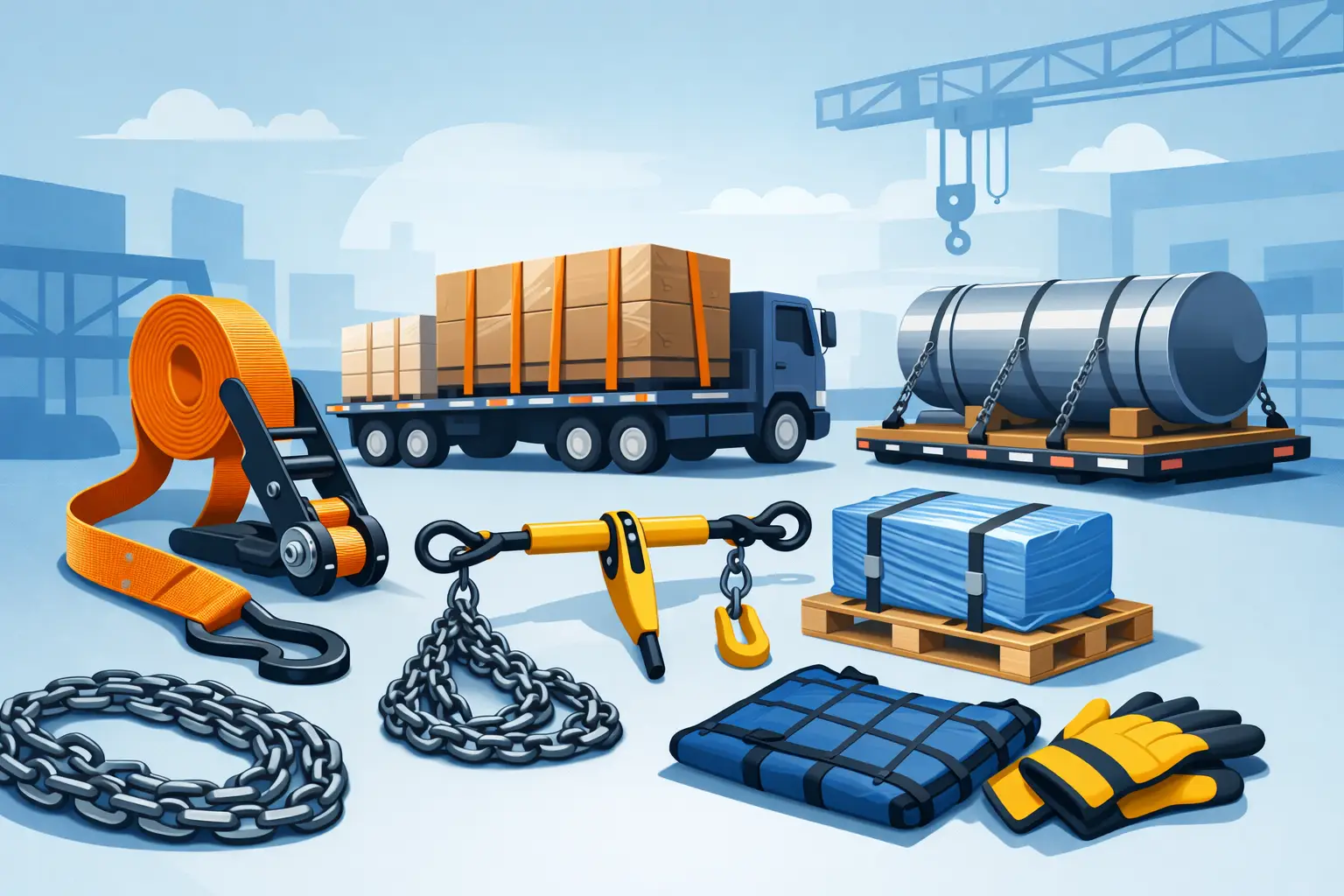
The equipment commonly used in industrial transport includes grade-rated transport chain, ratchet binders, lever binders, synthetic web straps, wire-rope assemblies, D-rings, lashing rings, shackles, hooks, corner protectors, tarps, and cargo bars. Each product has a purpose. The correct choice depends on the cargo and how it is being moved.
Start With the Load and the Transport Route
Before choosing hardware, define the load in practical terms. Weight matters, but it is not the only factor. A compact steel component and a long section of pipe may weigh the same while requiring entirely different restraint methods. Load geometry, center of gravity, surface condition, stacking method, and potential for rolling or sliding all affect securement requirements.
A tracked excavator, for example, often requires chain tie-downs connected to approved machine tie-down points. Pipe, casing, or tubular goods need restraint against rolling, often using cradles, chocks, or blocking in addition to lashings. Palletized consumables may be suitable for webbing straps when edges are protected and the cargo is stable. Equipment with sharp edges, hot surfaces, or rough castings can quickly damage synthetic materials and may call for chain or wire-rope solutions instead.
Route conditions also change the equation. A paved highway run and a rough lease-road transfer do not place the same demands on cargo control. Offshore and maritime applications introduce salt exposure, vessel movement, and longer periods under tension. In these cases, corrosion resistance, inspection frequency, and compatible lashing points deserve added attention.
Working Load Limit Is the Selection Baseline
Working Load Limit, or WLL, is the maximum load a component is designed to support in service under stated conditions. It is not a number to estimate, round up from memory, or substitute with breaking strength. Securement assemblies must be selected according to applicable regulations, company procedures, manufacturer instructions, and the required aggregate restraint capacity for the cargo.
Read the markings on every component. Chain grade and size, binder rating, hook type, shackle WLL, and strap tag information should be visible and legible. When hardware lacks identification, its rating cannot be verified. Removing unidentified equipment from service is usually less expensive than dealing with a failure, claim, or delayed shipment.
Be careful when combining components. The assembly must be rated to its lowest-rated part. If a chain has adequate capacity but the hook, shackle, anchor point, or binder has a lower WLL, that lower rating governs the entire connection.
Choose the Right Securement Method
Chain assemblies remain a preferred option for heavy machinery, structural steel, and rugged loads because they handle abrasion and demanding field use well. Grade 70 transport chain is widely used for cargo securement, while alloy chain may be specified for particular lifting applications. These categories are not interchangeable simply because both are chain. Confirm the intended use, markings, and applicable requirements before deployment.
Ratchet binders provide controlled tensioning and are often favored where crews need adjustment with reduced handle kickback risk. Lever binders can be fast and effective in experienced hands, but they require proper handling procedures and adequate clearance. Neither binder style should be selected on speed alone. Consider crew training, working space, tensioning requirements, and the likelihood of repeated adjustment during transit.
Synthetic web straps are efficient for finished equipment, crated materials, and loads where surface protection matters. Their trade-off is vulnerability to cuts, abrasion, melting, and chemical attack. Use edge protection wherever straps contact corners or rough surfaces. A low-cost protector can prevent the costly loss of a strap and the much greater risk of cargo movement.
Wire-rope lashing assemblies can be useful where abrasion resistance and durable construction are needed, particularly in certain marine and industrial applications. They require careful attention to end fittings, clips, sockets, thimbles, kinks, crushed sections, and corrosion. Do not assume a wire-rope assembly remains serviceable because it still looks generally intact from a distance.
Anchor Points and Hardware Need Equal Attention
Anchor points are frequently overlooked because they are part of the trailer, deck, rack, or cargo frame rather than the tie-down assembly itself. Yet an anchor point must have adequate capacity, sound attachment, and an angle that allows the securement device to work as intended. A bent D-ring, cracked weld, elongated hole, or severely corroded lashing point is a stop-work issue, not a cosmetic concern.
Use compatible connectors. Hooks should seat properly without tip loading or side loading. Shackles should be correctly sized, pinned, and oriented to avoid damaging the body, pin, or connected hardware. Avoid forcing multiple components into a connection point when a properly rated master link, shackle, or dedicated connector would provide a cleaner arrangement.
Tie-down angle affects performance. A flatter angle may provide limited downward restraint, while a more vertical arrangement may provide less resistance to forward or lateral movement. The correct configuration depends on the required restraint direction and available anchor locations. If the geometry is poor, adding tension alone is not the answer. Reposition the load, add blocking, use additional securement, or change the connection layout.
Inspection Is Part of the Equipment Purchase
Industrial load securement equipment should be inspected before use, during transit when practical, and after exposure to abnormal conditions. A useful inspection program separates routine user checks from documented periodic inspections performed by qualified personnel.
Remove equipment from service when it shows damage that can affect capacity or safe operation. Common warning signs include stretched or bent chain links, damaged hooks, distorted binder handles, missing safety latches where required, cracked welds, illegible identification, cut webbing, damaged strap stitching, heat damage, corrosion, wire-rope kinks, broken wires, and damaged end fittings.
Field crews also need a clear quarantine process. Damaged gear should not be set aside where it can return to circulation. Tag it, isolate it, and determine whether the manufacturer permits repair or whether replacement is required. For many components, unauthorized field repair creates more risk than value.
Build a Reliable Securement Inventory
A practical inventory supports the work crews actually perform. Standardizing on common chain sizes, binder types, shackle configurations, strap lengths, and replacement parts can reduce selection errors and simplify replenishment. At the same time, standardization should not force every unusual load into a routine setup.
Keep critical spares available for high-use operations: rated hooks, shackles, ratchet assemblies, strap protectors, chain repair links where permitted, and replacement pins for approved hardware. Record item numbers, WLLs, dimensions, and manufacturer specifications so purchasing teams can reorder the exact equipment rather than relying on vague descriptions.
Pro Oil Field Supply supports this process with rated load-securement products, recognized industrial brands, and sourcing support for specialized requirements. For urgent jobs, the useful question is not simply whether an item is in stock. It is whether the item has the correct rating, configuration, documentation, and delivery path to keep the operation moving safely.
The best securement system is the one crews can verify quickly, install correctly, inspect confidently, and trust through the final mile. That standard protects people, preserves valuable equipment, and keeps the next job from waiting on a preventable failure.






One thought on “Industrial Load Securement Equipment Selection”
Pingback: Cargo Tie Down Inspection Field Checklist - Pro Oil Field Supply